Beef tariff-free in the US: what changes for Brazil
Trump confirmed that imports of beef from Brazil and Argentina will remain tariff-free in the United States amid quality concerns, while Brazilian exports fell 27.1% in August.

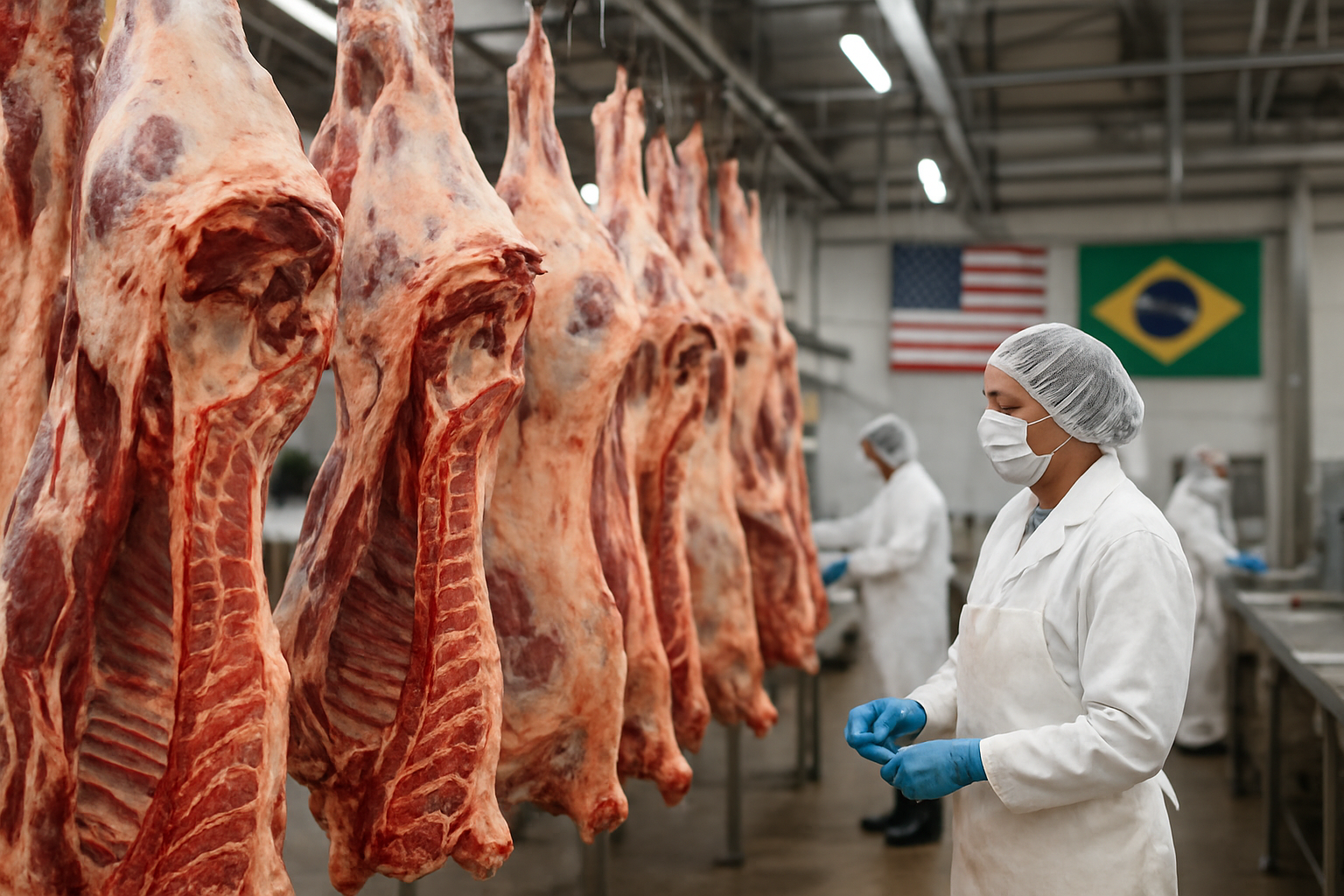
Donald Trump confirmed that imports of beef from Brazil and Argentina will continue to enter the United States without additional tariffs, even amid political controversies over product quality and pressure from US producers, according to Forbes Brasil [1]. The decision preserves tariff-free access to one of the most competitive markets in the world, precisely when the sector faces quality questions and non-tariff barriers in other destinations.
At the same time, Brazil's beef exports fell 27.1% in August, according to Notícia Toda Hora [2]. For those operating imports, exports, ocean freight and long-term contracts, this combination of volume decline and maintained tariff preference in the American market pressures price, routing, lead time and negotiations with meatpackers and trading companies.
What was decided and what the numbers show
According to Forbes Brasil [1], Donald Trump confirmed he will continue allowing imports of beef from Brazil and Argentina without the application of additional tariffs. The discussion takes place amid an intense political debate in the United States, with groups linked to the US livestock sector questioning the quality and safety of the imported product and advocating greater protection for domestic producers.
The decision, according to the report, preserves the current access status of Brazilian beef to the American market, which had been the target of criticism and threats of restriction from some domestic US sectors. In other words, there is no new tariff or change in rate, but rather confirmation that there will be no additional surcharge on Brazilian and Argentine beef at this time [1].
Meanwhile, total Brazilian beef exports fell 27.1% in August, as reported by Notícia Toda Hora [2]. The article indicates a significant decline compared with the same prior period, without detailing specific causes in this summary, but making clear that shipped volume fell materially.
Objective fact: on one side, the US remains without an additional tariff on Brazilian beef; on the other, Brazil exported 27.1% less beef in August [1][2]. For those working in logistics and foreign trade, these two combined data points suggest reallocation of flows, pressure on more competitive channels (such as the US market) and the need to revise contracts, export-dedicated slaughter capacity and freight plans for the second half.
Practical impact on cost, lead time, documents, routing and contracts
From a tax standpoint, the confirmation that there will be no additional US tariff keeps the current customs cost structure for Brazilian beef in that market, as described by Forbes Brasil [1]. No new fee is added to the American importer's bill nor an extra tariff barrier for the Brazilian exporter. The immediate impact is no increase in customs cost on entry to the US.
That does not mean the total operation cost will remain stable. With Brazilian beef exports down 27.1% in August [2], there is a tendency to redistribute volume across markets. That reallocation tends to affect:
- Refrigerated ocean freight (reefer) negotiations: lower total volume can reduce occupancy on some services, but concentration on more profitable routes such as the US may sustain or even raise freight on those lanes, depending on competition for space on ships with limited reefer plug availability.
- Booking window: with more players prioritizing the US market because it is tariff-free [1], the reservation window can tighten, requiring bookings further in advance during peak shipment weeks.
- Contractual terms: FOB and CFR contracts will see stronger debates about who pays what in the cold chain: pre-carriage to port, terminal energy costs, reefer container detention and potential rollovers if space is lacking.
On the documentation side, focus tends to shift from tariffs to sanitary and traceability requirements, since the political debate in the United States revolves around alleged quality issues of the imported beef [1]. Practically, this translates into:
- Tighter sanitary compliance: any nonconformity in veterinary certification, temperature, labeling or origin can gain political weight and be used as an argument for a non-tariff barrier, even without a formal tariff change.
- Strengthening of reports and supplementary documentation: more conservative importers may demand additional quality certificates, plant audits and temperature-control reports for the voyage, beyond what regulation strictly requires.
On routing, maintaining tariff-free access to the US [1] tends to further consolidate traditional corridors of beef to the US East Coast and Gulf, via Brazilian ports with robust reefer infrastructure. At the same time, the 27.1% drop in total exports [2] forces meatpackers and trading companies to reassess the destination mix:
- Greater relative weight of the US in the market portfolio;
- Review of slot allocation contracted with carriers on less competitive routes;
- Renegotiation of long-term freight contracts when actual volume does not match forecasts.
Supply contracts with US importers also come under review. The maintenance of the tariff-free condition [1] opens the door for commercial discussions about sharing upside (for those who had priced in the risk of a future tariff) and about revision clauses should sanitary barriers arise. Buyers of beef inputs for processing also feel the effect: the fall in total exports [2] may create occasional domestic oversupply, pressuring local prices and creating room to renegotiate supply contracts, including tolling operations for export processing.
The TMLOG perspective
In our view, there are three layers to this movement.
First, the domestic political interest in the US. The confirmation that beef from Brazil and Argentina will continue entering without additional tariffs [1] occurs in an environment of competing interests: on one side, the American consumer and supply-chain links that benefit from more competitive meat; on the other, domestic producers pushing for protection under the argument of quality and sanitary safety. The quality narrative, in this context, is also a tool for political and commercial bargaining.
Second, the potential exaggeration of the immediate-risk narrative. Reports highlight controversies and questions about the quality of Brazilian beef [1], but the concrete fact at this moment is: no new tariff was imposed. For the Brazilian operator, this means that today the obstacle is less about tariffs and more about regulatory and sanitary stability. The press tends to amplify the threat of market closure. For shippers, the operational focus should be meeting existing rules with margin and shielding operations against any gap that could be used as an argument for future restriction.
Third, what really changes for the client. The 27.1% drop in beef exports in August [2] shows the sector is already adjusting course. Maintaining tariff-free access to the US [1] makes that market even more strategic. In practice, this calls for concrete actions:
- Immediately review volume allocation strategy: assess how much of slaughter capacity and production lines make sense to redirect or preserve for US contracts, given current tariff conditions.
- Harden sanitary and document compliance: treat every shipment as if under political audit; eliminate any basic nonconformity in certification, temperature, labeling and traceability.
- Negotiate freight and contracts based on the new volume scenario: with a sharp drop in total exports [2], revisit quantity commitments in freight contracts and adjust booking lead times and cancellation clauses.
- Diversify without abandoning what works: keep efforts in other markets, but do not neglect the US channel, which currently remains tariff-free [1] and under political scrutiny — requiring more control and less improvisation.
In the coming weeks, the priority for exporters and industries that depend on beef will be to align production, commercial and logistics with the scenario of lower overall volume [2] and greater scrutiny on quality in key markets [1]. Those who secure operational stability, predictable shipments and flawless documentation are likely to get through this period with fewer shocks than those who treat the issue as a distant political debate.
Practical alert: a common mistake is to assume that, because there is no additional tariff in the US today [1], the main risk has gone away and operations can run "on autopilot." The most likely short-term risk is not a surprise new tariff, but a shipment blocked or delayed due to documentary or sanitary failure, in an environment where the quality of Brazilian beef is under political scrutiny. Reviewing certificate issuance routines, temperature checks and data verification before shipment is more urgent than debating future tariff scenarios that, for now, have not materialized.
Sources
International trade and logistics specialist with experience in import, export, customs clearance and international business development at TMLOG Global Trade & Logistics.
LinkedIn